The Creative Testing Framework Every Marketing Team Will Swear By in 2025
If you worked in marketing before 2020, you probably remember how everything felt “manual.” Targeting was a craft. Interests mattered. Lookalikes felt like magic. You could spend days adjusting audiences, exclusions, and placements, and still squeeze out an 8% improvement.
Then the last four years happened.
Algorithms matured. Targeting faded. Automation took over.
And suddenly, the only battlefield left is the creative.
Not audience lists.
Not bidding tricks.
Not funnel hacks.
Just the story you tell, the face that delivers it, and the first three seconds that decide whether someone stops or scrolls.
This blog isn’t another list of “test hooks, angles, formats”, you already know that.
This is the deeper framework behind why creative testing works and how top-performing B2B and SaaS advertisers will approach it in 2025.
Consider this a blueprint you won’t find in generic blogs.
Why Creative Testing Has Become the New Targeting
A decade ago, the audience defined who saw your ad.
In 2025, your creativity defines your audience.
Meta’s system now builds micro-clusters of viewers based on how they react to your creative.
Meaning:
If your video attracts people who love automation tools, Meta finds more automation-focused users.
If your hook attracts frustrated restaurant owners, Meta expands into that cluster.
If your angle hits founders who can’t hire more staff, Meta hunts for similar profiles.
Your creative doesn’t just “perform.”
Your creative trains the algorithm.
This flips the old rulebook.
What used to be “show the right ad to the right person” is now:
“Create the ad that attracts the right person, and the algorithm will find more of them.”
That single shift is why creative testing is no longer optional.
The 2025 Reality: B2B Buyers Are Entering Ads Like Netflix Viewers
Many marketers still build ads like they’re writing corporate brochures, polished, safe, and painfully careful.
But your buyers?
They’re scrolling on Meta the same way they consume everything else:
- 3-second attention
- 1-second judgment
- Constant comparison
- Zero patience for boring content
A CTO doesn’t stop watching memes when he gets promoted.
A founder doesn’t stop engaging with relatable pain points just because her company grew.
Today’s B2B buyer is not “professional” 24/7.
They are human 24/7.
Creative testing works because it helps you tap into the human first, and the “professional role” second.
The 2025 Creative Testing Framework
Most frameworks feel like a checklist.
This one is a lens. A way of seeing creative testing differently.
It has three layers, and they work in a loop, not a line.
Layer 1: The Moment Test
“Does the first 3 seconds feel like something worth stopping for?”
The hook is not a line.
It’s a moment.
You can test five hooks and still fail, because all your hooks sound like ads.
The Moment Test is simple:
If someone scrolls and instantly thinks:
“Wait… that’s me.”
or
“Hold on… what are they saying?”
or
“Oof… I felt that.”
You’ve won the moment.
Real 2025-proven hooks for B2B/SaaS:
- A micro-frustration: “Ever sent a proposal and then heard nothing for 4 days?”
- A human confession: “I used to spend 3 hours a day answering support tickets.”
- A reversal: “Your sales team doesn’t need more leads. They need this.”
- A reveal: “Watch this dashboard fix a problem you’ve had for months.”
Moments beat messages.
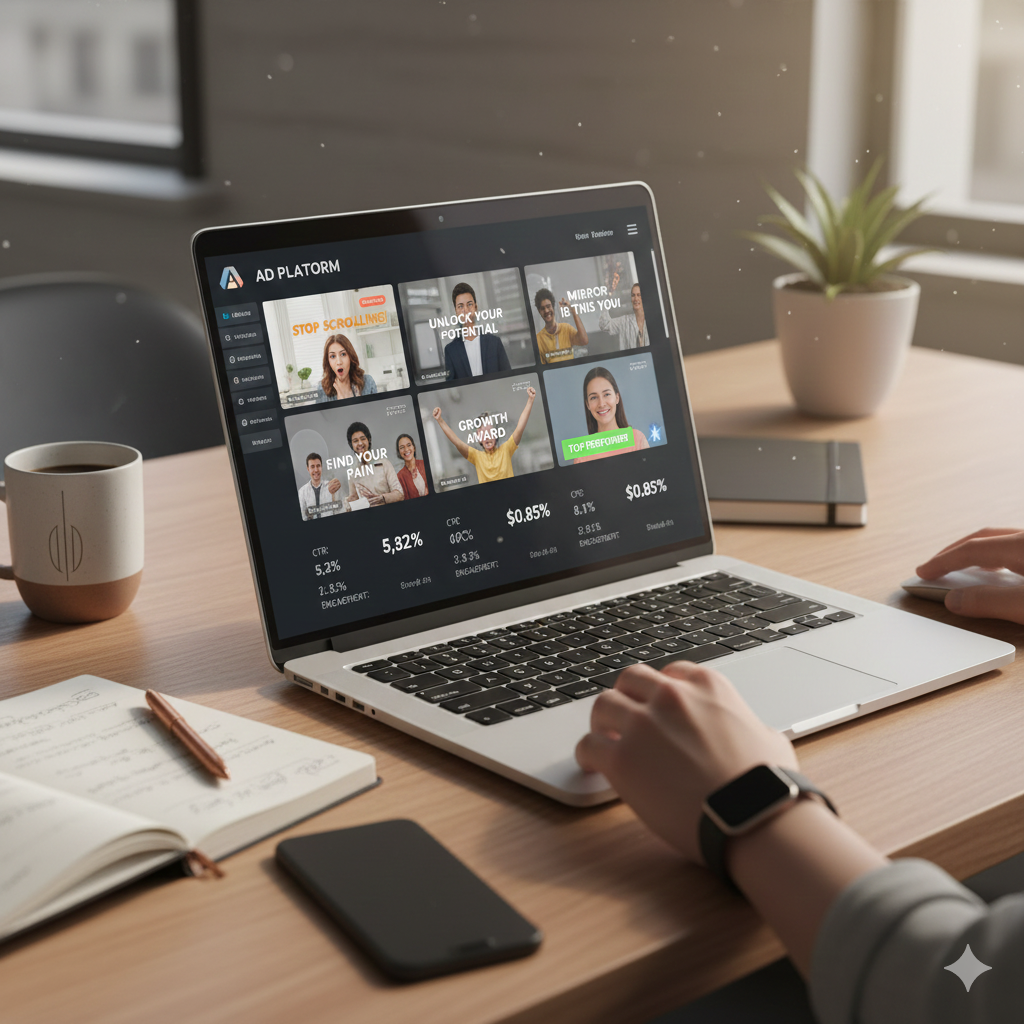
Layer 2: The Mirror Test
“Does the viewer see someone who feels like them?”
In 2025, avatar choice matters more than script choice.
Meta’s data shows that people pause slightly longer when the person in the video looks or speaks like them, even if nothing else changes.
This is why one creative with a 50-year-old hotel owner avatar might outperform a younger SaaS founder avatar by 37%, for the exact same script.
This is the Mirror Test in action.
Your job is not to pick the “best” avatar.
Your job is to mirror your market.
Test:
- age
- gender
- tone
- industry persona
- accent
- pace of speech
You’re not just testing faces.
You’re testing trust.
Layer 3: The Meaning Test
“Does the message solve a problem people actually think about at 11:30 pm?”
This is where old frameworks fail.
Most angles focus on product features or “efficiency gains.”
Buyers don’t stay awake thinking about efficiency.
They stay awake thinking about:
- the client they might lose
- the lead they didn’t follow up on
- the revenue they must hit next quarter
- the team they can’t scale
- the workflow that breaks every time
Creative testing becomes powerful when your angles go beyond marketing language and speak to the “midnight problem.”
Examples:
Not this:
“Automate your staff scheduling with ease.”
Try this:
“Your restaurant shouldn’t fall apart every time one person calls in sick.”
Not this:
“Faster onboarding for new hires.”
Try this:
“How many hours did you train your last hire? Exactly. Let the system do it this time.”
The Meaning Test cuts through noise because it speaks the buyer’s language, not the marketer’s.
The Loop: How Teams Use This Framework Weekly
Here’s how high-performing SaaS and service brands apply this in practice:
Week 1:
Test 5 “moments” → Find 1 that consistently stops scrolls.
Week 2:
Take the winning moment → record 3 avatar variations.
Week 3:
Take the winning avatar → test 3 “midnight problem” angles.
In three weeks, you don’t just find a good creative.
You discover a story pattern that keeps winning across formats.
This is how Unicorn SaaS companies scale consistently.
Why This Framework Works Better Than Old Advice
Because it respects the way humans actually consume content in 2025.
- We react to moments
- We trust mirrors
- We act on meaning
This is not a theory.
It’s what top ad accounts, performance agencies, and in-house SaaS teams are shifting toward right now.
A Quick Example from a Real 2025 Ad Account
A B2B service brand ran a simple test:
5 moments:
1 pattern interrupt
1 frustration line
1 visual shock
1 blunt truth
1 stat
One line crushed everything else:
“Do you really want your leads to ghost you again this week?”
Thumb-stop rate jumped by 46%.
Lead cost dropped by 38%.
No fancy editing.
Just the right moment.
They then introduced avatar testing:
- young woman (professional tone)
- middle-aged man (calm tone)
- restaurant owner (relatable tone)
The relatable avatar won.
Not because of quality.
Because of identity.
Then they added meaning:
“Leads don’t ghost you because they’re busy. They ghost because you’re not following up fast enough. Fix that in 24 hours.”
That creative scaled the entire account.
One framework.
Three layers.
One massive shift.
The Teams Who Win in 2025 Aren’t the Ones With the Best Tools
They’re the ones who understand people.
The algorithm doesn’t reward creativity.
It rewards clarity.
It rewards relatability.
It rewards truth.
The creative testing framework of 2025 isn’t about running dozens of variations.
It’s about finding the moment, the mirror, and the meaning — and letting the algorithm do its job.
If your marketing team applies this every week, you won’t just improve ads.
You’ll reshape the way your brand communicates, sells, and stands out in a crowded world.